Now Playing "Le Cygne - The Swan" by Saint Saens
Excerpts From the introduction to Walden by Edward Hepburn, published by Peebles Press International, Inc
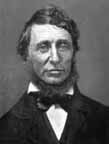
When Henry David Thoreau died in 1862 at the age of forty four he was virtually unknown. He had had two books published and a handful of essays. The first book, A Week on the Concord and Merrimack Rivers, was a total failure. After a year or so the unsold copies-706 out of an edition of 1000 - were returned to the author, who wrote with wry humour: "I now have a library of nearly nine hundred volumes, over seven hundred of which I wrote myself. Is it not well that the author should behold the fruits of his labor? My works are piled up on one side of my chamber half as high as my head, my opera omnia. This is authorship; these are the work of my brain."
His second book, Waldon, attracted only a handful of readers. If Thoreau was remembered at all during the second half of the 19th century, he was remembered for the wrong reasons. James Russell Lowell, the eminent critic, set the tone with an essay first published in 1865 which led to a general estimate of Thoreau as an unreadable, egocentric misanthrope. Later it became the fashion to dismiss Thoreau as purely a nature writer. He was remembered, and occasionally read, as "the poet-naturalist," a term fastened upon him with the best of intentions by his enthusiastic friend and walking companion, Ellery Channing. It was well over half a century afier his death before Thoreau's very special qualities and the real meaning of his work began to be appreciated.
Today Thoreau is generally acknowledged as one of the greatest and most original of American writers. He is admired for his gem-like prose, his vigorous, salty imagery, his eloquently precise descriptions of nature, and above all for his forthright championing of the worth and dignity of the individual. His books are available in countless editions around the world, and has often been imitated. In particular his essays on man and society, especially the famous one on Civil Disobedience, have been acknowledged by Gandhi and later practitioners of militant non-violence in politics as their inspiration and textbook. But these essays, these flashes of momentary anger, should not be considered as Thoreau's principal legacy to the thought of man-kind, for his lasting message is to be found scattered through all his work, but especially in his masterpiece, Walden, of 1854.
The reader of Walden and his other writings will discover that Thoreau speaks far more directly to the condition of mankind in this dangerous, unsettled time than he ever did to the people of his own century. Thoreau lived in a period of rising prosperity, of expansion, of rapid industrialiation, a period dominated by materialistic values. From the vantage point of today, of course, the peaceful, pastoral America of Thoreau's day would seem like a paradise on earth. Nevertheless, as an arch-individualist, Thoreau did not like what he saw, and he said so. But the young America of the 1800's, happily flexing its new found muscles, pushing south and westwards into Texas and California, building its factories and its railroads, coursing the oceans in search of trade and amassing wealth and land at a dizzy pace paid little attention to Thoreau.
Today however the tendencies that Thoreau saw -- a smothering materialism, the pressures towards conformity, the dominance of the state and other organized institutions, the increasing subservience of man to the machine - have grown so monstrously large and threatening that, unlike Thoreau's contemporaries of the 1800's, we are at last beginning to realize that our lives, our future, even our souls are in jeopardy. We are ready now to listen . His vibrant words sound out in all their freshness and immediacy: "It is for want of a man that there are so many men. It is individuals that populate the world." "The mass of men lead lives of quiet desperation." "Why should we be in such desperate haste to succeed, and in such desperate enterprises?". " If a man does not keep pace with his companions, perhaps it is because he hears a diferent drummer. Let him step to the music which he hears, however measured or far away."
Once when Emerson boasted to a young admirer that Harvard taught all branches of learning, Thoreau spoke up: "yes, indeed, all the branches and none of the roots." The Mexican War had the scarcely concealed aim of extending the slave-holding area into the South-west, and rather than pay the poll tax to help finance the war, he went to jail for a night - which gave rise to his famous essay, Civil Disobcdience. He was alive to the menace of property and affluence ("a man is rich in proportion to the number of things he can afford to let alone"). Simpify, simpify was his constant cry.
Thoreau was sounding the alarm against the insidious dangers of what we would now call our industrial-technological civization. "I do not propose to write an ode to dejection," he wrote with his usual jauntiness, "but to brag as lustily as chanticleer in the morning, standing on his roost, if only to wake my neighbours."
Thoreau has been much misunderstood, both in his time and in ours. He is generally thought of as the hermit of Walden Pond, who retired to the woods to get away from it all and to write about nature. Nothing could be further from the truth. E. B. White, the American humorist, sums it up: "He got a reputation for being a naturalist, and he was not much of a naturalist. He got a reputation for being a hermit, and he was no hermit. He was a writer, is what he was." While at Walden Thoreau entertained a constant stream of visitors, interrupted his stay to go on a trip to Maine with a companion, and often wandered into nearby Concord to visit his friends or his family.
After graduating from Harvard Thoreau tried schoolteaching for a bit, but it was foreordained that such a prickly individualist would never be able to hold, or would want to hold, a conventional job. In 1845 he built himself a cabin on the shores of Walden Pond, near Concord, on land belonging to his older friend and mentor, Ralph Waldo Emerson, and lived there for a little over two years while he put together the manuscript of his first book, A Week on the Concord and Merrimack Rivers. More important, he also drafted the first sketch of his second and most sigificant book, Walden: or, Life in the Woods. When he felt that he had accomplished his purpose for going there, he left Walden with no regrets and for the rest of his life lived in Concord, making his living by manufacturing pencils and graphite dust with his father, and later acting as the town surveyor.
Walden is a record of the two years Thoreau spent by the pond, but actually, it is much more. There is some account of his outward life at Walden, roughly arranged to cover the seasons, from Summer around to Spring, and the book contains some of the most sensitive and lovely nature writing that has ever been written; but the most lasting and valuable aspect of Walden is its record of Thoreau's inner life and his message to the world. His pervading theme is: How should a man live his life? The writing is confident, hopeful, challenging and wise. Thoreau retired to Walden Pond not only to learn to write, but also to learn how to live. "I went to the woods because I wished to live deliberately, to front only the essential facts of life, and see if I could not learn what it had to teach, and not, when I came to die, discover that I had not lived... I wanted to live deep and suck out all the marrow of life."
Thoreau preaches the need to live one's own life honestly and to the full, no matter how this may be accomplished. There is no need for most men to lead lives of quiet desperation, he says. Let them wake up to their full potential, let them discard the non-essentials and live their lives to the full. "I learned this, at least, by my experiment:" he writes at the end of Walden, "that if one advances confidently in the direction of his dreams, and endeavors to live the life which he has imagined, he will meet with a success unexpected in common hours."
Like most arch-individualists, Thoreau found it difficult to get along with people and so turned to nature, for which he had a genuine love and interest. If he did not feel at home in offices and drawing rooms, at least he could feel at home in the woods, fields and rivers. "I have met with but one or two persons in the course of my life" he wrote, "who understood the art of Walking, that is, of taking walks, who had a genius, so to speak, for sauntering." He used to describe his occupation, with mock seriousness, as that of "Saunterer," for it was on his walks that he got his material for his writing. In words that echoed Jesus he wrote: "If you are ready to leave father and mother, and brother and sister, and wife and child and friends, and never see them again-if you have paid your debts and made your will, and settled all your affairs, and are a free man, then you are ready for a walk."
Thoreau used nature, and his observations of nature, as a means of commenting on society and the condition of man. As E.B. White says, he was not much of a naturalist, though he did write some fine essays on the succession of forest trees, and on the lakes and ponds of Concord. His forte lay in using nature as a mirror in which to examine himself and as an excuse to philosophize about the art of living. This was made easier for him because he believed in the current philosophy of Transcendentalizsm, which combined a romantic outlook with a pervasive morality to teach that "the mind properly stirred and lifted could go direct by intuition to the sources of absolute truth" - and this could be discovered equalty in man and in nature. Thus in studying nature Thoreau believed that he was also increasing his understanding of man. Thoreau once confided to his Journal that he was no scientist but rather "a mystic, a transcendentalist, and a natural philosopher to boot."
How did he go about this discovery of nature, and of man in nature,? By sauntering, of course, and observing and thinking while he walked. But also by means of recording his thoughts and observations in his Journal, which he kept daily from 1837, the year he left Harvard, until shortly before his death in 1862, and which in the end amounted to thirty-nine large volumes. He took notes in the field, and would copy out his daily entries each night. From these journals he laboriously constructed Walden and his other books, and for this reason all Thoreau's work reads in sentences, rather than in paragraphs. Almost eveiy sentence is a thought or an observation distilled from his Journals. Walden is not easy to read as a connected narrative, though it does have a good deal of subtle organization. To read Thoreau one should think of it as poetry, with all the concentration of ideas and emotions into nuggety statements that is characteristic of the best Poetry. Or it should be read as people read the Bible, a little at a time, finding a treasure here to be savoured, putting the book down and coming back to it later to find other treasures. Thus read, it is inexhaustible and grows on one.
Links